Staffing vs Automation for the October-December Returns Rush
.JPG)
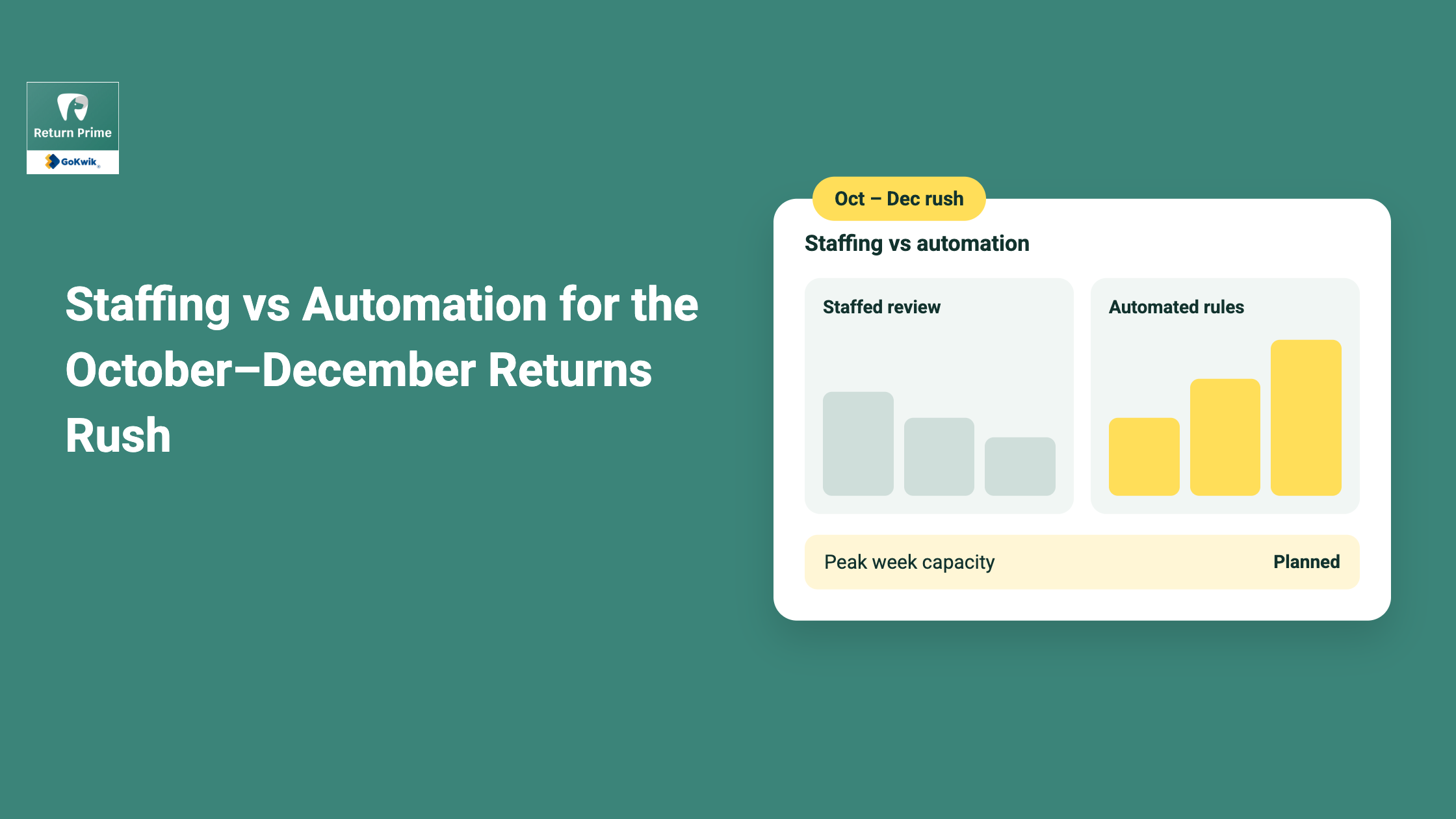
Hiring temporary support staff for the holiday returns rush is the default instinct for most merchants, and it's the wrong first lever to pull for the bulk of what actually needs handling. The right question isn't staffing versus automation as an either-or choice, it's which specific tasks genuinely need a human and which don't, and getting that split wrong wastes both money and goodwill.
Why temporary staffing alone doesn't scale well
Hiring and training take real lead time you don't get back. A temporary support hire brought on in November needs onboarding time before they're genuinely productive, time that eats into the exact weeks you need full capacity, unlike automation rules that, once configured and tested, work identically on day one of the surge as day thirty.
Volume during this period isn't flat, it's a curve. As covered in our forecasting guide, October through December return volume rises and falls across distinct waves, Halloween, Thanksgiving week, Black Friday, Christmas, New Year, each with different timing and characteristics. Staffing a flat headcount against a curved demand pattern means either under-resourced peaks or wasted capacity in quieter stretches.
Most routine return decisions don't actually need human judgment. A low-value return from a customer with clean history, requesting a standard size exchange, doesn't benefit from a human reviewing it, it benefits from being resolved instantly. Routing this kind of request to a person is slower for the customer and more expensive for you than automating it.
Where automation should carry the load
Routine approval and exchange processing. Wonder Bot Automation handling auto-approval for low-risk requests, per the segmentation framework covered in our risk framework guide, removes the bulk of routine volume from any human queue entirely.
Notification and status communication. Proactive updates at each stage of a return or exchange, covered in our notification guide, reduce the "where is my refund" inquiries that would otherwise consume support capacity regardless of staffing level.
Gift-flow and exchange-default routing. Gift-specific return handling and defaulting toward exchange over refund are workflow logic decisions, not judgment calls, well suited to automation rather than a human deciding case by case.
Where humans should still be involved
Genuinely high-value or high-risk requests, flagged by your segmentation rules for manual review, where judgment about condition, fraud risk, or an unusual situation genuinely benefits from a person's assessment.
Corporate or bulk gifting order resolution, covered in our B2B returns guide, where relationship context and consolidated communication matter more than workflow speed alone.
Escalations and disputes, covered in our escalation handling guide, where a customer is unhappy enough that automated resolution has already failed to satisfy them.
Edge cases your automation rules weren't built to anticipate, which will always exist at some volume, and where a human catching and handling them well prevents a bad customer experience from an automation gap.
The actual decision framework
Rather than asking "how many temp staff do I need," ask: what share of expected volume can automation handle end-to-end without human involvement, and what's genuinely left over that needs a person? Size your staffing plan against that remainder, not against total expected volume, and you'll typically need meaningfully fewer temporary hires than the naive calculation would suggest.
What good staffing-and-automation balance looks like
A merchant that has automated the routine majority of return and exchange processing before the season starts, sized a smaller, well-trained team specifically for the genuine exceptions, high-value review, disputes, corporate orders, and used forecasted volume curves to schedule that smaller team against actual peak weeks rather than a flat headcount across the whole season.
Install Return Prime from the Shopify App Store to automate the routine majority of your holiday returns volume before deciding how much temporary staffing you actually need.
FAQs
Does this mean I don't need any temporary staff for the holidays?
Not necessarily zero, but likely fewer than a naive volume-based calculation would suggest, since automation should be absorbing the routine majority of requests.
What if my automation rules make a mistake during peak volume?
This is exactly why manual review thresholds matter, genuinely uncertain or high-value cases should route to a human by design, limiting the blast radius of any automation misconfiguration.
How do I know what share of my volume automation can actually handle?
Review your historical return data for what share was low-value, clean-history, standard requests versus genuinely complex cases; that ratio is a reasonable starting estimate for your automation-versus-human split.
Should I still train staff even if automation handles most volume?
Yes, the remaining human-handled cases are, by definition, the harder ones, and deserve well-trained attention, not less investment simply because they're a smaller share of total volume.





.svg)


.svg)