Segmenting Festive Shoppers by Return Risk: A Practical Framework
.JPG)
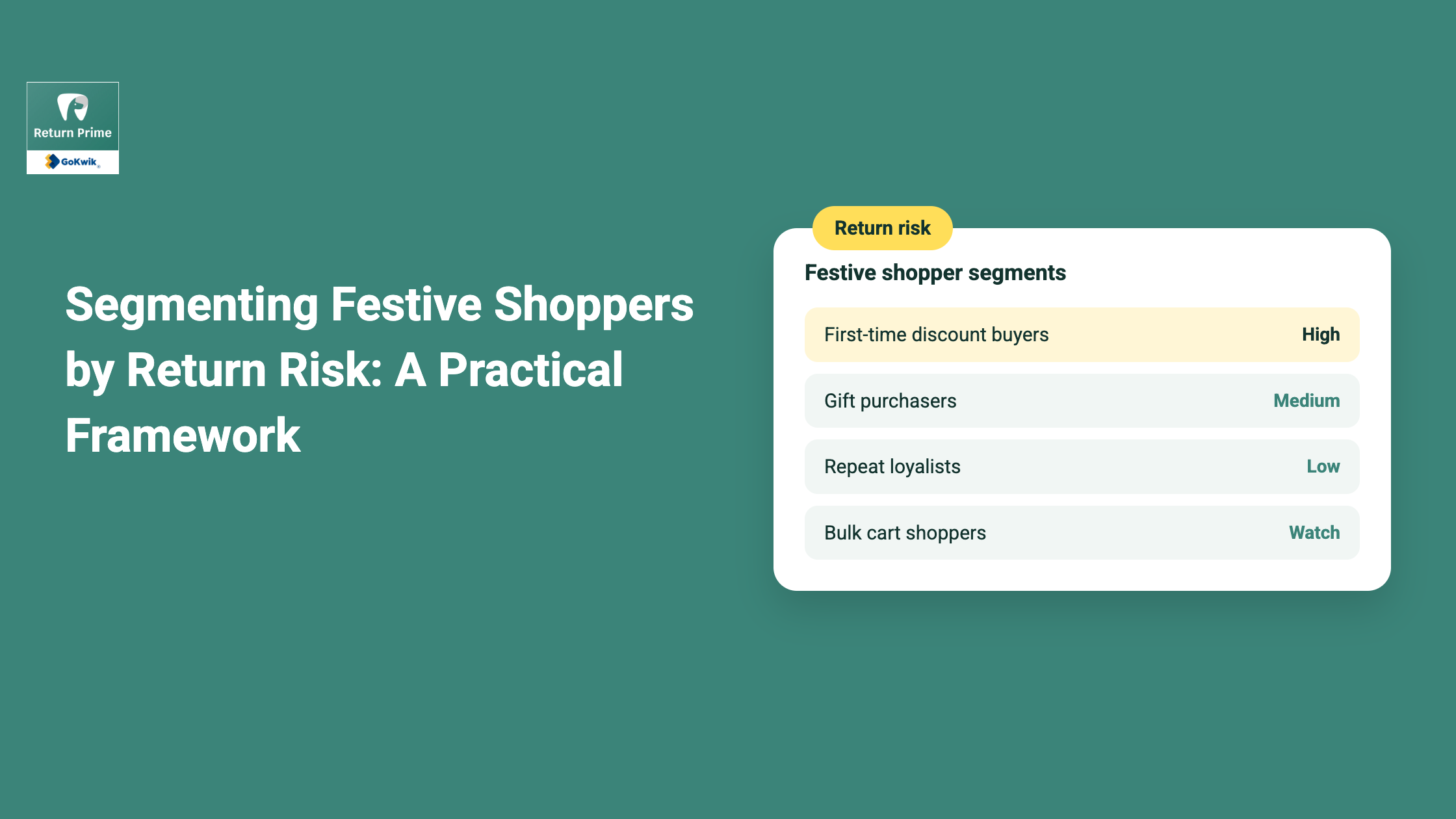
Not every customer carries the same return risk, and treating every festive-season order with identical scrutiny wastes review capacity on low-risk orders while giving genuinely risky ones the same light-touch treatment as everyone else. Segmenting by risk, rather than applying one blanket policy, is how you actually protect margin without adding friction for your best customers.
The segments worth distinguishing
Repeat customers with a clean return history. A customer who has ordered and returned reasonably before is a low-risk segment worth fast-tracking, auto-approval, minimal friction, since their historical behavior already tells you what to expect.
First-time customers during a major sale event. New customers acquired during Black Friday, Diwali, or similar high-volume promotional periods carry more uncertainty simply because you have no history with them yet, not because they're inherently more likely to abuse a policy, but because you genuinely don't know yet.
Customers with a documented pattern of high-frequency or high-value returns. This is a genuinely different risk tier, worth flagging for manual review rather than automatic approval, distinct from ordinary bracketing behavior which, as covered in our fraud detection guide, is now mainstream enough to plan capacity around rather than treat as inherently suspicious.
Orders in categories with structurally higher return and fraud risk. Apparel, jewelry, and electronics carry different baseline risk than lower-consideration categories, independent of the specific customer, and your segmentation should account for category risk alongside customer-level history.
Gift-flagged or gift-receipt orders. These carry a different risk profile entirely, covered in our gift returns flow guide, since the return-initiator often isn't the purchaser, and the appropriate resolution path (exchange or store credit rather than refund) differs structurally from a standard return.
Building a practical segmentation model
You don't need a sophisticated predictive model to start, a workable framework can begin with a small number of clear rules: auto-approve low-value returns from customers with clean history, route high-value or repeat-flagged returns to manual review, apply category-specific thresholds for structurally higher-risk product types, and route gift-flagged returns through your distinct gift-resolution flow by default.
Why this matters more during festive season specifically
Festive season concentrates your highest order volume, your highest share of first-time customers, and your highest exposure to bracketing and fraud, all in the same compressed window. A segmentation approach that works fine at normal-month volume can break down if applied uniformly at festive-season scale, either by approving too much low-scrutiny volume or by manually reviewing far more than your team can actually process in time.
What good segmentation looks like in practice
A merchant that auto-approves the bulk of low-risk, low-value returns from established customers without any manual touch, routes high-value and repeat-flagged returns to a dedicated review queue, applies category-specific thresholds for jewelry and electronics distinct from lower-risk categories, and handles gift-flagged returns through a separate, exchange-first flow entirely, rather than running every request through one undifferentiated queue.
How Return Prime supports this
Wonder Bot Automation supports rule-based routing across exactly these dimensions, customer history, order value, product category, and gift status, letting the bulk of low-risk festive volume move through automatically while genuinely risky or high-value cases get the manual attention they warrant.
Install Return Prime from the Shopify App Store to set up rule-based risk segmentation before your festive volume hits.
FAQs
Do I need customer data history to start segmenting, or can I begin with category and value alone?
You can start with category and order-value rules alone if customer history data isn't readily available yet, and layer in customer-level segmentation as that data accumulates over subsequent seasons.
Is flagging first-time customers as higher-risk unfair to legitimate new shoppers?
It's not a judgment about the individual customer, it's an acknowledgment of genuine uncertainty given no prior history; the goal is proportionate scrutiny, not blanket suspicion, and most first-time customers should still experience a smooth process.
How granular should category-level risk thresholds be
?Start broad (apparel and jewelry higher scrutiny, most other categories standard) and refine as you accumulate your own category-specific return and fraud data over time.
Does this replace the need for manual review entirely?
No, it concentrates manual review where it's actually warranted, on the smaller share of genuinely higher-risk requests, rather than eliminating manual review or applying it uniformly to everything.





.svg)


.svg)