Preparing Customer Support for the Holiday Return Wave: A Shopify Guide
.JPG)
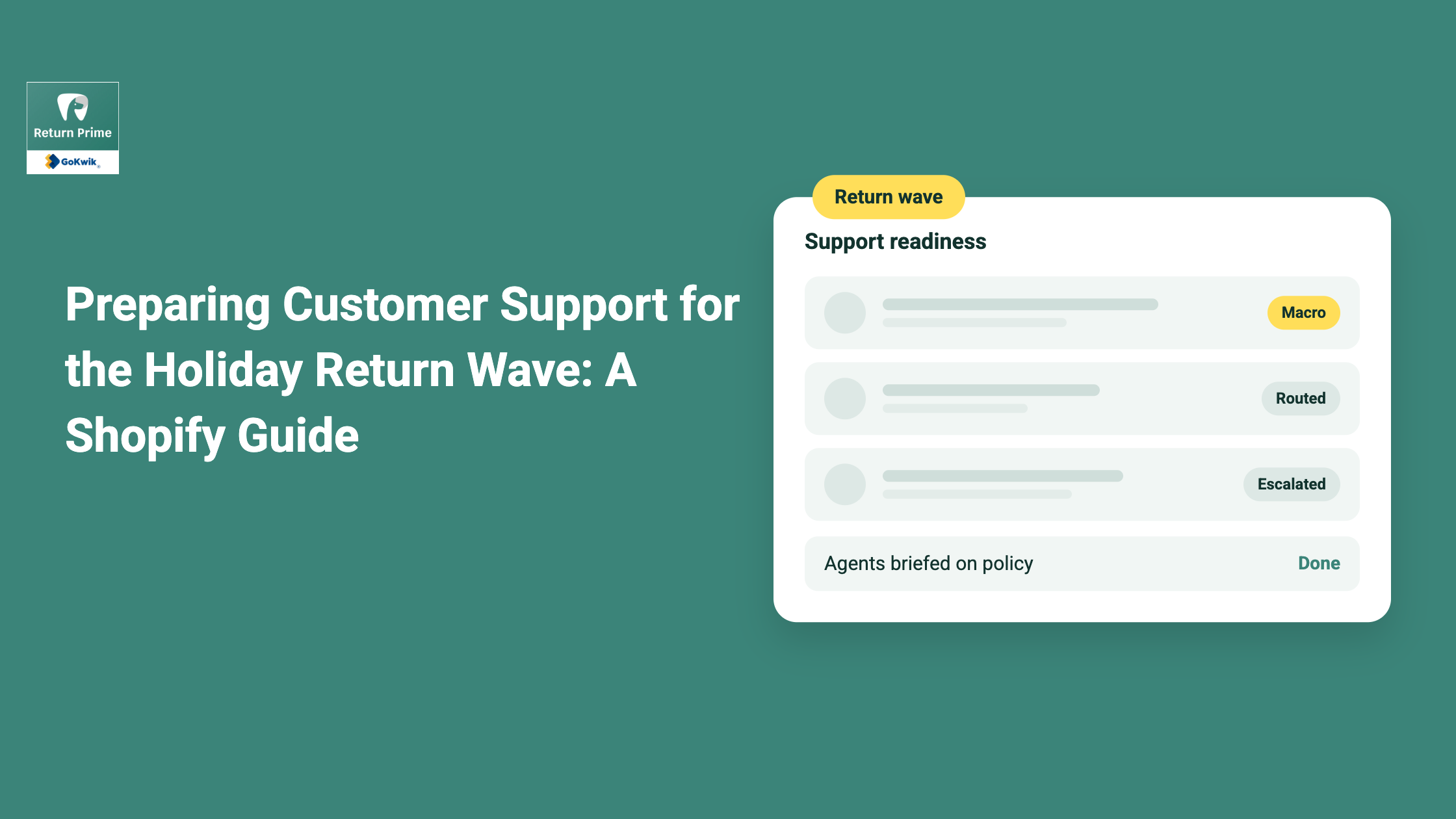
Customer support teams typically prepare extensively for holiday sales volume, order inquiries, shipping questions, product recommendations, and far less for the returns wave that follows, even though it's often a larger and more sustained support burden than the sales rush itself. Getting support genuinely ready for returns specifically requires different preparation than getting ready for sales.
Why returns-specific support prep is different from sales prep
The tone and urgency of a returns conversation differs from a sales inquiry. A customer asking about a return is often already somewhat frustrated, a wrong size, a disappointing gift, a delayed delivery, which calls for different training and scripting than a pre-purchase product question.
Returns support spans a much longer window than the sales rush itself. Given the documented 10 to 12 week return horizon retailers now plan for around the holidays, support capacity needs to hold up well beyond the concentrated sales period, into January and sometimes February.
Returns support requires different knowledge than sales support. Policy terms, exchange logic, refund timing, and courier status meanings (like the RTO and RTB distinction covered elsewhere in this cluster) are specific knowledge areas a support agent trained mainly on product and sales questions may not be equipped to handle confidently.
What to actually prepare before the wave hits
Train support specifically on your festive-specific policy terms, not just your standard policy. If you're running an extended holiday return window or a distinct gift-return process, as covered throughout this cluster, your support team needs to know these terms confidently before customers start asking, not learn them reactively mid-ticket.
Prepare clear, ready-to-use response templates for the most common returns-related questions. Where is my refund, how do I return a gift I received, why was my return declined, having consistent, accurate, pre-approved language for these recurring questions speeds up resolution and reduces the risk of an agent giving inconsistent information under pressure.
Brief support on what's automated versus what needs their direct involvement. If Wonder Bot Automation is handling routine approvals and notifications automatically, support needs to understand this clearly so they're not manually re-doing work the system already handled, or, conversely, missing genuine exceptions that do need their attention.
Set clear escalation criteria and handoff process in advance. As covered in our escalation handling guide, support needs to know exactly when and how to hand a difficult case to whoever has escalation authority, rather than each agent making an inconsistent individual judgment call.
Plan capacity against your actual forecasted volume curve, not a flat assumption. As covered in our forecasting guide, returns support needs matter more in specific weeks than others, staff and schedule against that curve rather than a flat headcount across the whole period.
Reducing support load before it ever reaches a person
The most effective support preparation is often reducing how much volume reaches a human at all. Proactive notifications at each stage of a return, clear policy visibility on your theme and product pages, and automated resolution for routine requests all reduce the volume that ever generates a support ticket in the first place, which is a more scalable strategy than simply preparing a larger team to handle more tickets manually.
What good support preparation looks like
A team briefed specifically on festive and gift-return policy terms, equipped with consistent response templates for common questions, clear on what's automated versus what needs their direct attention, briefed on escalation criteria and handoff process, and scheduled against an actual forecasted volume curve rather than a flat assumption across the whole season.
How Return Prime supports this
Return Prime's automation and notification systems reduce the volume of routine returns questions that reach support at all, while the analytics dashboard gives support leadership visibility into actual return patterns and volume trends to plan staffing and training against, rather than guessing.
Install Return Prime from the Shopify App Store to reduce the return-related ticket volume your support team needs to handle manually this season.
FAQs
How far in advance should support training happen?
Several weeks before your peak volume begins, so agents are confident and consistent by the time real volume hits, not still learning policy terms mid-surge.
Should support agents know how the automation system works, or just the customer-facing policy?
Both; understanding what's automated helps them avoid redundant manual work and correctly identify genuine exceptions that do need their attention.
Is reducing ticket volume through automation a support strategy, or just an operations one?
Both. It directly reduces the load your support team needs to handle manually, making it as much a support capacity strategy as a workflow efficiency one.
How do I know if my support team is adequately staffed for the actual wave, not just the sales rush?
Compare planned staffing against your forecasted returns volume curve specifically, not your sales volume curve, since the two peaks don't align in timing or duration.





.svg)


.svg)