Return and Refund Meaning: Definition, Differences and Examples
.JPG)
.png)
Kwik Answer
A return is when a customer sends a purchased product back to the seller. A refund is when the seller returns the customer's money. The two are related but not the same.
What Is a Return?
A return is the physical act of a customer sending a purchased item back to the seller, typically because the product did not meet expectations or wrong size, arrived damaged, not as described or simply not wanted.
According to Shopify, an ecommerce return occurs when a customer sends back something they bought online. It usually involves the customer requesting a return, shipping the item back, and then receiving a refund, store credit, or exchange.
Common reasons for a return:
- Wrong size or variant ordered
- Item arrived damaged or defective
- Product did not match the description or images
- Customer changed their mind
What Is a Refund?
A refund is the reimbursement of the customer's original payment issued to the original payment method, as store credit, or as a gift card. A refund can be full (the entire purchase price) or partial (a deduction for restocking, condition, or return shipping).
A refund does not always require the customer to return the item.
For low-value products where return shipping costs more than the item is worth, many brands issue a refund and let the customer keep or donate the product. This is called a returnless refund.
Key Differences: Return vs Refund
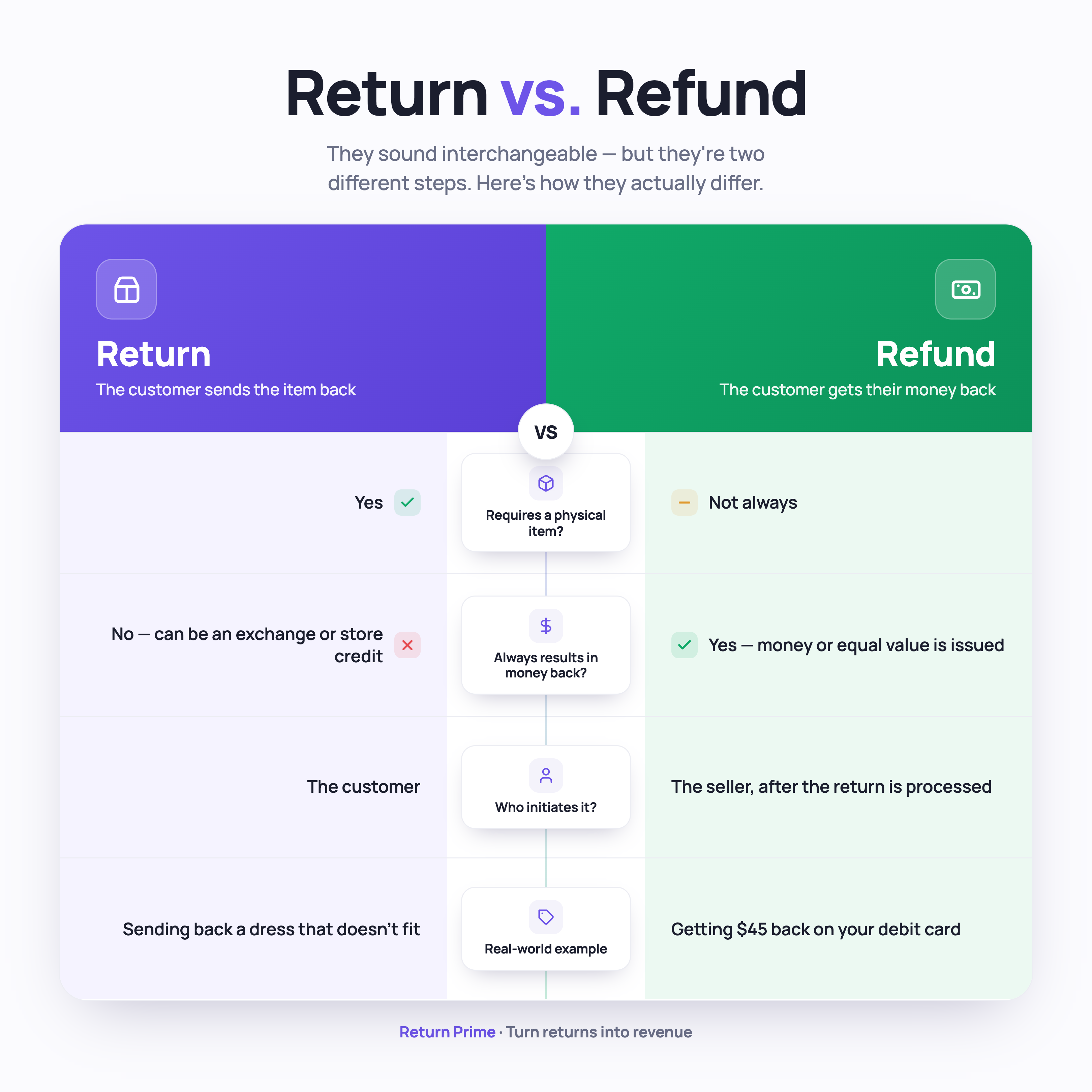
Return and Refund: Examples
Example 1 - Return with refund: A customer buys a pair of shoes online. They arrive and the size is wrong. The customer initiates a return through the brand's portal, ships the shoes back, and receives a full refund to their original payment method within five business days. Both a return and a refund occurred.
Example 2 - Return with exchange (no refund): A customer returns a shirt in size M and exchanges it for size L. The item is returned, but no money changes hands. A return occurred; no refund was issued.
Example 3 - Refund without return: A customer receives a damaged water bottle. The brand issues a full refund and asks the customer to keep or dispose of the item. A refund occurred; no return was required.
Example 4 - Return with store credit (not a cash refund): A customer returns a skincare product. Instead of a cash refund, the brand issues store credit with a 10% bonus. A return occurred; the resolution was store credit, not a refund to the original payment method.
Why the Distinction Matters for Shopify Brands
For D2C Shopify brands, every return is not automatically a refund. The resolution is a strategic decision that affects margin and retention.
Converting one refund into an exchange generates a total revenue swing of approximately $360 over two years, versus a $50 loss on the refund. That gap exists because a refund removes revenue from the business, while an exchange retains it.
According to the National Retail Federation, nearly 17 out of every 100 products sold were sent back. At that volume, the difference between a return that resolves as a refund versus one that resolves as an exchange or store credit is material to profitability.
Return Prime is a returns management platform for Shopify brands that handles returns, exchanges, store credit and refunds from a single self-serve portal. Install here for FREE.
FAQs
1. Can you get a refund without returning the item?
Yes. Some brands offer returnless refunds for low-value items where the logistics cost of a return exceeds the product's value. The customer keeps or donates the item and receives a full refund.
2. Does a return guarantee a refund?
No. A return can result in a refund, a store credit, or an exchange, depending on the brand's return policy and the resolution the customer selects.
3. What is a partial refund?
A partial refund is when the seller reimburses only a portion of the original purchase price. For example, if the item is returned in a condition that reduces its resale value, or if return shipping costs are deducted from the refund amount.
4. What is the difference between a refund and store credit?
A refund returns money to the customer's original payment method. Store credit retains the equivalent value inside the brand's ecosystem, to be used against a future purchase. Store credit is not cash — it can only be spent with that brand.





.svg)


.svg)