Return and Refund Meaning: A Complete Guide for Online Shoppers and Shopify Stores
.JPG)
.png)
Ever placed an online order, received something wrong, and wondered: do I return this or do I ask for a refund? Are they the same thing?
Most customers use "return" and "refund" interchangeably, but they refer to two distinct steps in the post-purchase journey. For Shopify store owners, this confusion often leads to unclear policies, frustrated customers, and unnecessary support tickets.
This guide breaks down the return and refund meaning in simple terms: what each process involves, how they differ, when one triggers the other, and what best practices look like for eCommerce businesses in 2025.
Key Takeaways
- A return is the physical act of sending a product back to the seller.
- A refund is the financial reversal of a payment to the customer.
- Returns and refunds are related but not always the same — one can happen without the other.
- Clear return and refund policies directly reduce customer disputes and WISMO queries.
- Exchanges are a third option that can retain revenue while resolving customer issues.
What Does "Return" Mean in eCommerce?
A return refers to the process where a customer sends a purchased product back to the seller or manufacturer. It is a physical action. The item travels back through the supply chain, from the customer to the fulfillment center or warehouse.
Returns are typically initiated when:
- The product received is different from what was ordered
- The item arrives damaged or defective
- The customer changes their mind or finds a better alternative
- The product does not fit (common in fashion and footwear)
- The delivery arrived too late for its intended purpose
A return does not automatically guarantee a refund. The seller may inspect the returned item before deciding whether to issue a refund, replacement, or store credit. This is why understanding the return process is important before initiating one.
What Does "Refund" Mean in eCommerce?
A refund is the reversal of a payment. The seller returns the money a customer paid for a product or service, either partially or in full.
Refunds can be issued in multiple forms:
- Original payment method - Amount reversed to the card, UPI, or wallet used at checkout
- Store credit - A balance added to the customer's account for future purchases
- Gift card - A redeemable code of equivalent value
- Bank transfer - Direct deposit to the customer's bank account
Importantly, a refund can be issued without a return in certain scenarios. For example, if a product is lost in transit, damaged beyond use, or if the seller offers a goodwill credit for a poor experience.
Return vs Refund: What's the Difference?
The confusion between the two terms is understandable. Here's a clear comparison that breaks down where they diverge.
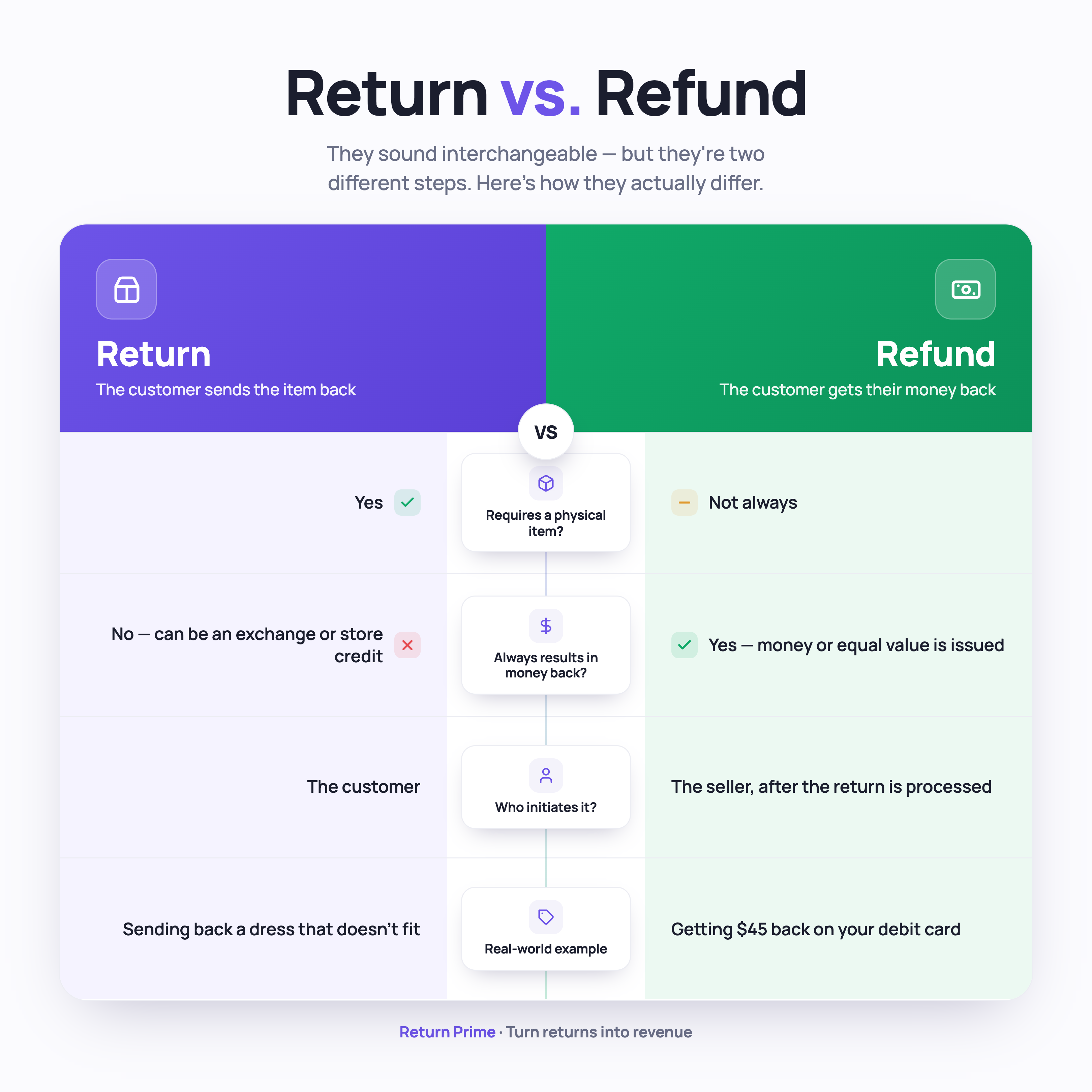
Understanding this distinction helps customers know what to expect and helps store owners write clearer policies.
What is a Return and Refund Policy?
A return and refund policy is a formal document that outlines the rules under which a seller accepts returned products and processes refunds. It acts as a contract between the seller and the buyer.
A complete return and refund policy typically covers:
- Eligibility window - How many days after purchase a return is accepted (e.g., 7, 15, or 30 days)
- Condition of the item - Whether the product must be unused, unopened, or in original packaging
- Non-returnable items - Categories like innerwear, perishables, or digital products often excluded
- Refund method - Whether money is returned to the original payment method or as store credit
- Return shipping - Who bears the cost of shipping the item back
- Processing time - How long the refund takes after the return is received and inspected
For Shopify store owners, a well-written return and refund policy reduces disputes, builds buyer trust, and protects the business legally.
Types of Refunds Explained
Not all refunds are the same. Here is a breakdown of the different types customers and store owners encounter:
1. Full Refund
The complete purchase amount is returned to the customer. This is typically issued when the product is defective, not as described, or if the order was cancelled before shipment.
2. Partial Refund
Only a portion of the amount is refunded — often when the product is returned in used or damaged condition, or if a discount is applied to account for usage.
3. Store Credit Refund
Instead of returning money, the seller issues a credit that can be used on future orders. This is increasingly popular in eCommerce as it retains revenue while still resolving the customer's concern.
4. Exchange Instead of Refund
The customer receives a replacement product — a different size, colour, or variant — instead of getting money back. This is the preferred resolution for fashion, footwear, and lifestyle brands.
5. Goodwill Refund
Issued at the seller's discretion even when the situation does not technically qualify under the return policy — for example, after a poor delivery experience or as a loyalty gesture.
How the Return and Refund Process Works: Step by Step
Understanding the end-to-end process helps both customers and sellers manage expectations.
Step 1: Customer raises a return or refund request via the store's portal, email, or chat support.
Step 2: The seller reviews the request against their return policy by checking eligibility, reason, and timeline.
Step 3: If approved, the customer is provided a return label or pickup is arranged by the logistics partner.
Step 4: The item is shipped back and received at the seller's warehouse or fulfillment center.
Step 5: The returned item is inspected for condition and authenticity.
Step 6: Based on the inspection outcome, the seller processes a refund, store credit, or exchange.
Step 7: The customer receives the refund on their original payment method or the replacement item, depending on what was agreed.
For stores using automated platforms like Return Prime, this entire process is managed from a single dashboard, reducing manual effort and improving turnaround time significantly.
Common Misconceptions About Returns and Refunds
Myth 1: A return always means a refund
Fact: A return request may result in a refund, an exchange, or store credit depending on the seller's policy and the condition of the returned item.
Myth 2: Refunds are processed immediately
Fact: Refund timelines depend on the payment gateway, the bank, and the seller's internal processing. Most refunds take 3–10 business days to reflect in the customer's account after the return is approved.
Myth 3: Customers can return anything at any time
Fact: Return eligibility is governed by the seller's policy. Most stores have a defined window (7 to 30 days) and specific conditions the product must meet to qualify.
Myth 4: Free returns mean the seller pays nothing
Fact: Free return shipping is an expense borne by the seller. For high-volume stores, this cost is factored into pricing and logistics planning.
Myth 5: Return and refund policies are the same across all stores
Fact: Policies vary widely. Two Shopify stores selling identical products can have completely different return windows, refund methods, and non-returnable item categories.
What Is the Difference Between a Return, Refund, and Exchange?
Three terms (all part of the post-purchase experience) but each means something different.
TermWhat HappensWho Gets WhatReturnProduct goes back to the sellerSeller gets the itemRefundMoney goes back to the customerCustomer gets cash or creditExchangeProduct is swapped for anotherCustomer gets a replacement
Exchanges are often the most valuable option for eCommerce brands because they retain revenue while resolving the customer's complaint. Platforms like Wonder Smart Exchange make this easy by automatically suggesting the right replacement at the point of return.
Why Returns and Refunds Matter for Shopify Store Owners
For eCommerce brands, returns and refunds are not just operational tasks, they directly impact revenue, customer loyalty, and brand reputation.
Returns affect:
- Inventory levels and restocking cycles
- Logistics costs and reverse supply chain planning
- Product quality feedback and supplier decisions
Refunds affect:
- Cash flow and revenue recognition
- Customer lifetime value (CLV)
- Repeat purchase likelihood
Research consistently shows that customers who have a smooth, hassle-free return experience are more likely to shop again. A poor return experience, on the other hand, often leads to negative reviews and lost customers permanently.
How Return Prime Simplifies Returns and Refunds for Shopify Brands
Return Prime, a GoKwik company, is rated 4.8/5 on the Shopify App Store and is trusted by thousands of Shopify brands globally to manage their end-to-end return and refund workflows.
Take Bummer, a fast-growing D2C innerwear brand. Before Return Prime, they faced slow manual return handling and growing customer frustration. After switching:
- Return processing time dropped by 87.5% even during 2–3x higher order volumes
- Return requests fell by 74% using smart exchange workflows
Here is how Return Prime turns returns into a growth lever:
- Centralized Return Management –-Handle all returns, exchanges, and refunds from one dashboard with complete visibility
- Wonder Revenue Booster - Suggest relevant upsell products during the return flow to recover lost revenue
- Wonder Promotions - Convert refund requests into store credits with personalized incentives
- Wonder Smart Exchange - Retain revenue by automatically turning returns into exchanges
- Wonder Bot Automation - Automate repetitive return tasks to reduce manual workload
- Automated Notifications - Keep customers informed at every stage via Interakt, Limechat, Klaviyo, and Spur integrations
Conclusion
Understanding the return and refund meaning is the first step toward managing post-purchase experiences that build trust and loyalty. A return is the physical process of sending a product back; a refund is the financial process of reversing a payment. Both are interconnected but not always the same.
For Shopify brands, having a clear, fair, and easy-to-understand return and refund policy is a competitive advantage. Customers who trust your returns process are more likely to buy again.
Ready to turn your returns into a growth opportunity? Install Return Prime for FREE and see how the right tools can transform your post-purchase experience.
Frequently Asked Questions
1. What is the basic meaning of return and refund?
A return means the customer sends a product back to the seller. A refund means the seller returns the money to the customer. The two often happen together but are separate steps in the post-purchase process.
2. Can I get a refund without returning the product?
Yes, in some cases. If a product arrives damaged, is lost in transit, or the seller offers a goodwill gesture, a refund can be issued without requiring a physical return. This varies by seller policy.
3. How long does a refund take after a return?
Refund timelines vary. Once the returned item is received and inspected, most sellers process refunds within 2–5 business days. The amount then takes an additional 3-7 business days to reflect depending on the payment method and bank.
4. What is the difference between a refund and store credit?
A refund returns money to the customer's original payment method. Store credit is a balance added to their account that can only be spent at your store. Store credit benefits sellers by retaining revenue while still resolving the customer's issue.
5. Is an exchange the same as a return?
No. An exchange means the customer sends the product back and receives a different item in return, a different size, colour, or variant instead of getting money back. Exchanges help retain revenue and improve customer satisfaction simultaneously.
6. What should a return and refund policy include?
A complete return and refund policy should cover: the eligibility window, product condition requirements, non-returnable items, refund method, who pays for return shipping, and processing timelines. Clear policies reduce customer confusion and dispute rates.





.svg)


.svg)