End of Season Sale (EOSS) Returns: Winter Changeover for Shopify Brands
.JPG)
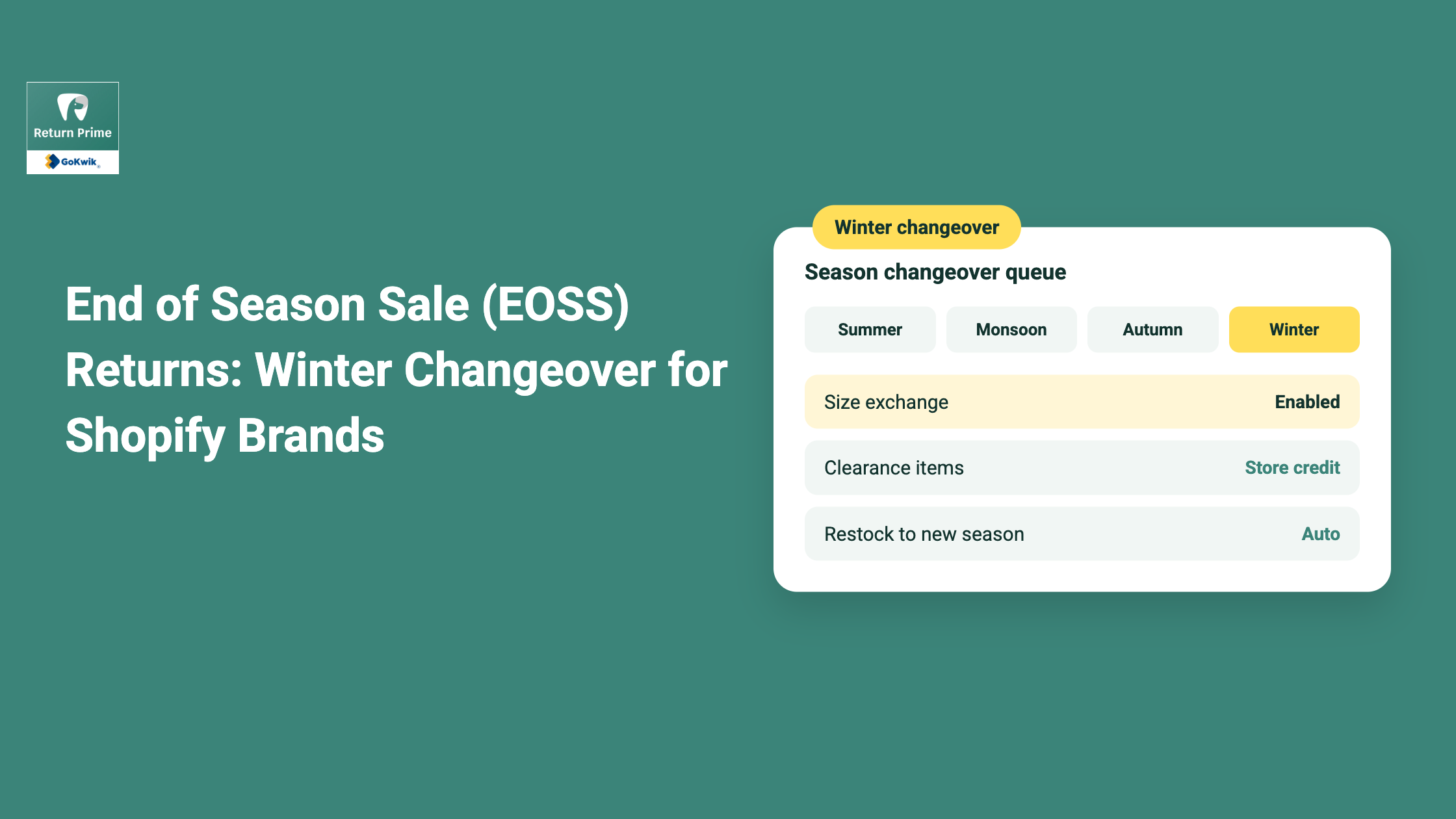
Winter End of Season Sales create a specific returns problem most merchants don't plan for separately: deep, clearance-level discounts drive volume up right as inventory is being cleared to make room for new stock, meaning the margin for absorbing return costs is thinner than at any other point in the year, right when volume is highest.
Why EOSS returns need distinct handling
Discount depth changes the return-cost math. A return on a product discounted 60 to 70% still costs roughly the same to process, pick, ship, receive, inspect, as a return on a full-price item, but the margin available to absorb that cost has shrunk dramatically. The same return that was comfortably profitable at full price can be a net loss at clearance pricing.
Sizing and fit issues spike on clearance purchases. Deep discounts pull in more opportunistic, less considered purchasing, "it was too good a deal to pass up" buying that doesn't always account for actual fit or need, which tends to elevate return rates on exactly the inventory you most need to move, not just receive back.
Restocking clearance inventory often isn't economically sensible. Unlike a full-price return, which gets restocked and resold, a returned clearance item may already be at the bottom of its viable price point, restocking and reselling costs can exceed what's recoverable, especially for end-of-life seasonal stock that won't be carried again next year.
What to actually do differently for EOSS specifically
Consider a distinct, more restrictive return policy for clearance and final-sale-tagged inventory, communicated clearly at the point of purchase. Our guide on mixed final sale and returnable policies covers exactly how to run both policies side by side on the same storefront without confusing shoppers.
Push exchange over refund more aggressively during EOSS specifically, since a sizing exchange keeps the sale (and the cleared inventory) rather than turning it back into stock you now need to move a second time.
Model your actual cost-per-return against your specific EOSS discount depth, not your general-season average, before deciding on policy. A blanket "same policy year-round" approach ignores that the underlying economics genuinely shift at clearance pricing.
Set clear expectations on defective versus change-of-mind returns for clearance stock. Genuine defects should be handled fairly regardless of discount depth; change-of-mind returns on deeply discounted, final-sale-adjacent inventory are the category worth being more restrictive about.
How this fits your broader seasonal calendar
Winter EOSS typically follows shortly after the holiday gifting season closes, overlapping with the New Year returns wave already working through your system. Running a distinct EOSS policy at the same time you're processing holiday gift returns requires clear internal segmentation, not just clear customer-facing policy, so your team and automation rules can tell the two apart.
What good EOSS returns handling looks like
A merchant that tags clearance inventory distinctly in its returns system, applies a more restrictive but clearly communicated policy on that specific tag, defaults to exchange over refund wherever a suitable size or item exists, and tracks return rate specifically on clearance SKUs separately from full-price return rate, rather than one blended number that hides where the actual margin risk sits.
How Return Prime supports this
Return Prime's return policy configuration supports SKU or collection-level policy overrides, letting clearance and final-sale inventory run under different rules than your standard catalog automatically, rather than relying on manual judgment calls at the point of each return request.
FAQs
Should all EOSS inventory be final sale?
Not necessarily all of it, but consider it deliberately for your deepest-discounted or genuinely end-of-life stock, where restocking economics are weakest.
Does pushing exchange over refund actually help during EOSS specifically?
Yes, arguably more than during full-price periods, since keeping cleared inventory sold (in a different size or item) avoids the double cost of processing a return and needing to move that same discounted stock again.
How is this different from a regular return policy?
The underlying customer-facing mechanics can be similar, but the economics justify a genuinely more restrictive policy on the specific inventory being cleared, which most merchants don't currently differentiate from their standard catalog.
Does this overlap with holiday return handling?
Timing-wise, often yes, which is why clear internal segmentation between clearance-tagged and gift-tagged returns matters, since both waves can be active simultaneously with different policy logic each.
Install Return Prime from the Shopify App Store to run a distinct, margin-aware return policy for your winter EOSS inventory alongside your standard catalog.





.svg)


.svg)